
Understanding the Different Types of Progressive Lenses (And why prices vary so much?)
Purchasing a pair of progressive glasses can feel overwhelming. The wide range in cost and the endless list of lens options often makes selecting the best progressive lens style for you confusing. In this post we will break down the different styles of progressive lenses, our recommendations, and why the cost can vary so much!
What are progressive lenses?
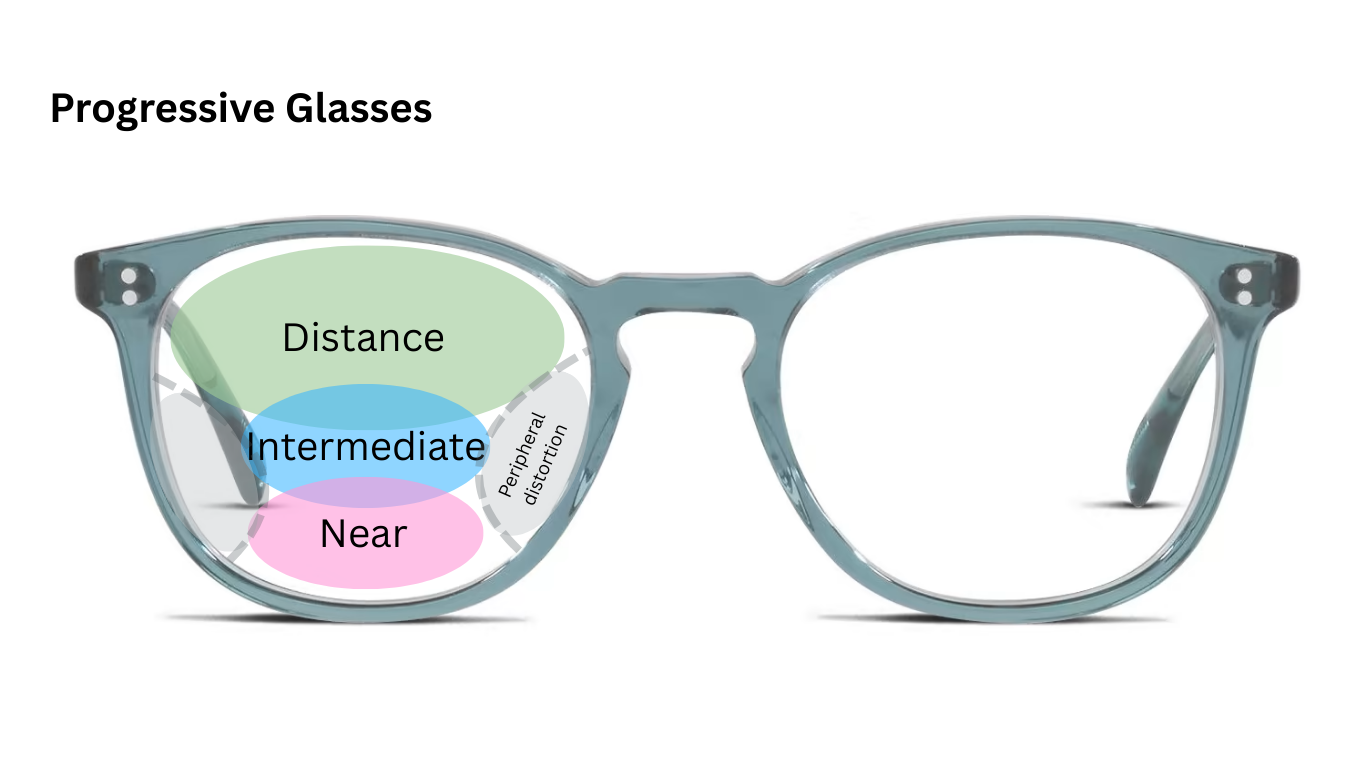
Progressive lenses are multifocal lenses with seamless gradual transitions between three prescription powers for distance, intermediate, and near vision. They allow wearers who need multiple prescriptions for different activities to see clearly at various distances with a single set of glasses. By moving their gaze to different zones of the lenses, wearers can smoothly and naturally switch between prescription powers for different activities like driving, using a computer, and reading.
The designs and technology behind progressive lenses and their smooth transitions are also what can make things complicated when it comes to selecting the best progressive lens styles for you. Below, we will break down the different styles of progressive lenses to help you make more informed decisions about your eye wear.
What is the difference between progressive glasses and multifocal glasses?
Progressives are multifocal glasses! “Multifocal” is the umbrella term for glasses lenses with multiple prescriptions in them. Within the multi-focal category there are several types of lenses: bifocals, trifocals, and progressive lenses.
What are bifocals and trifocals, and what are the advantages of progressives compared to them?
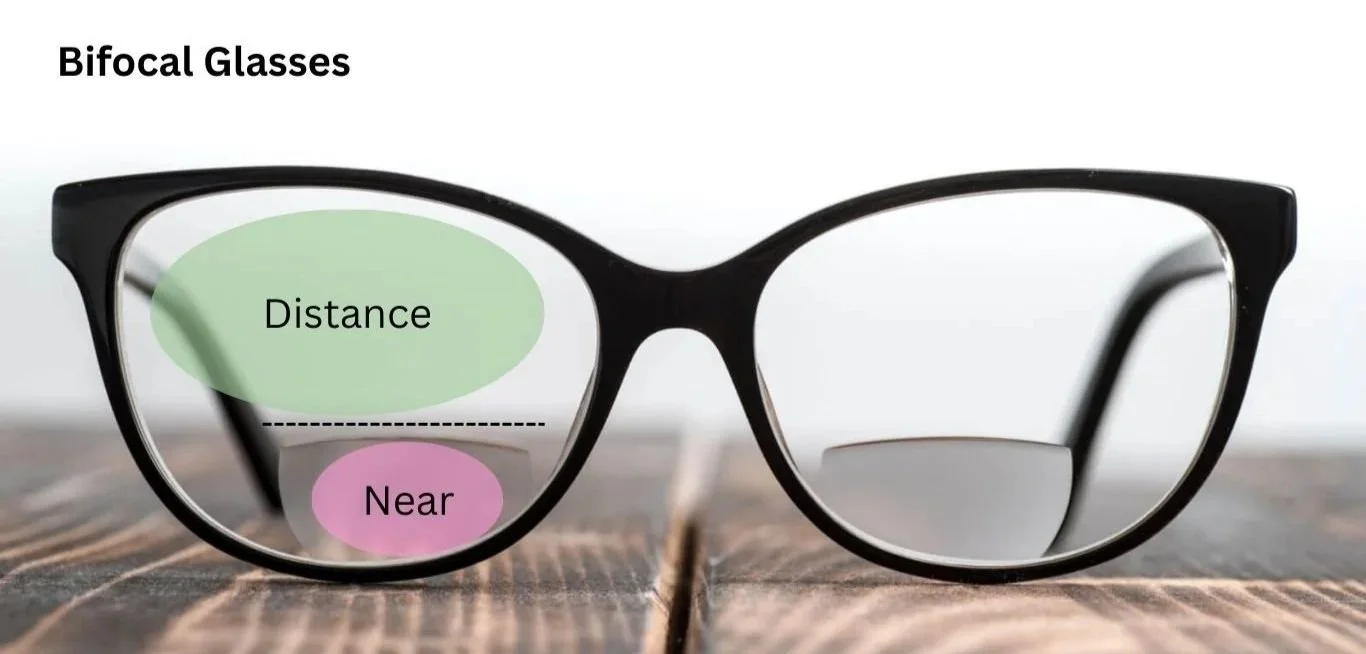
Bifocals: Lenses with two separate sections for your distance and near (reading) prescriptions, with a distinct line between the different prescription powers.
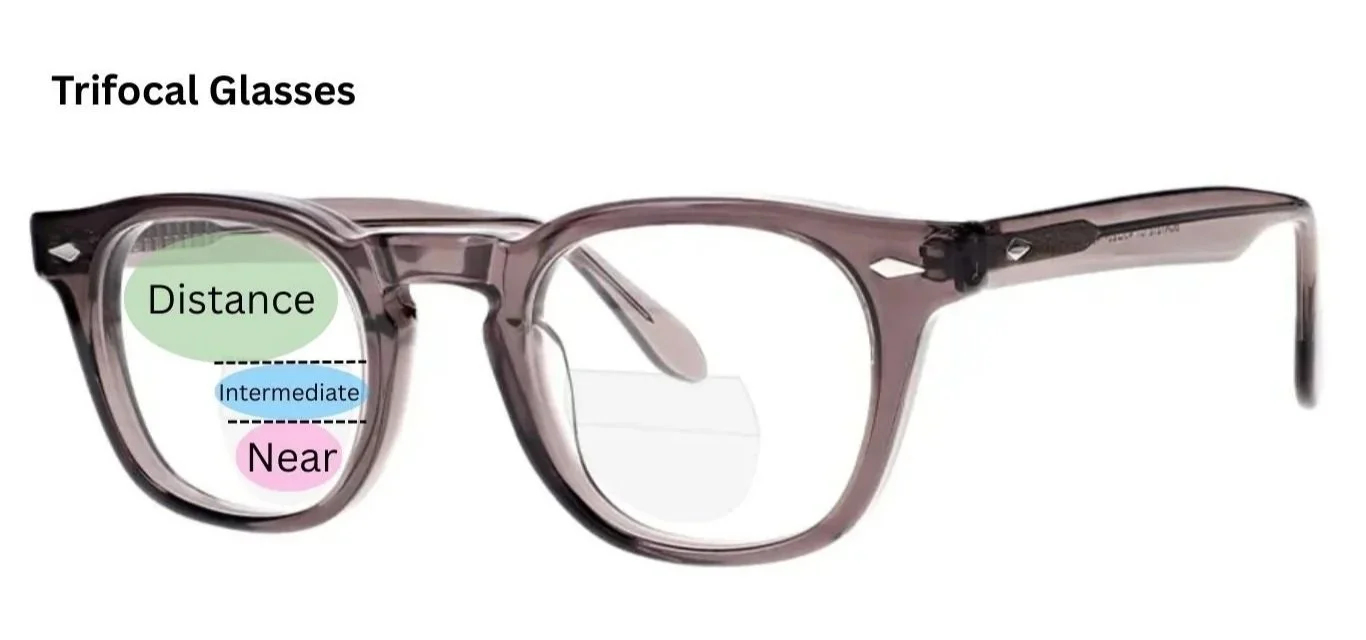
Trifocals: Lenses with three separate sections for distance, intermediate, and near prescriptions with distinct lines between the various prescription powers. Trifocals come in a variety of styles, such as flat top/D-segment, full width, and overhead, to best suit each user's lifestyle but all options have noticeable separate sections.
In comparison to bifocals and trifocals, progressive lenses offer a more natural and smooth wearing experience. This is due to the gradual transitions between prescription zones, instead of a sudden change. Many people also prefer the look of progressives and consider them an aesthetic upgrade since they eliminate the noticeable harsh lines that bifocals and trifocals have between each prescription power.
What are the different types of progressive lenses?
Standard progressive lens:
Price range: $540-820 depending on your recommended index
Ideal wearer: Patients who would like an affordable entry level progressive. Ideal for users wearing their glasses intermittently and those who primarily are needing their glasses for distance vision
Pros:
Budget conscious option
Widely available at most optometry clinics and optical stores
Cons:
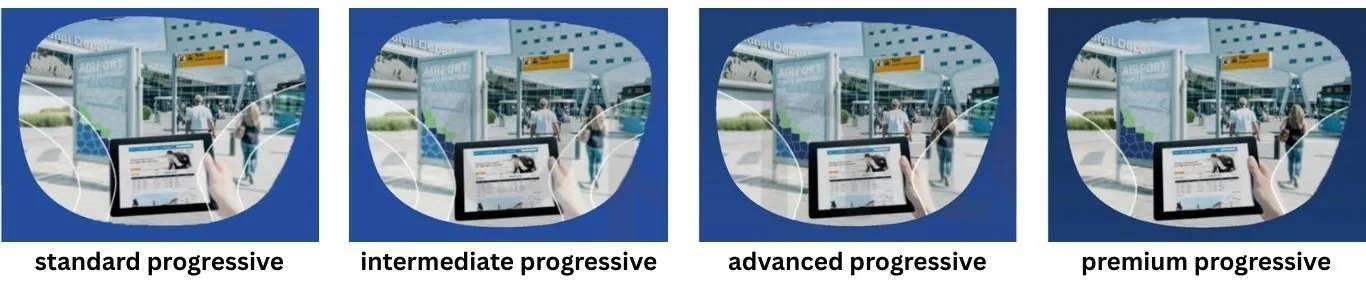
Narrow fields of vision especially in the near vision reading area
Larger amounts of distortion along the edges of the lenses.
Typically wearers experience a longer adaption period due to having to find more specific prescription zones in the lenses
Our recommended standard progressive: Hoya’s Maestro Gen 2
Office progressive lenses:
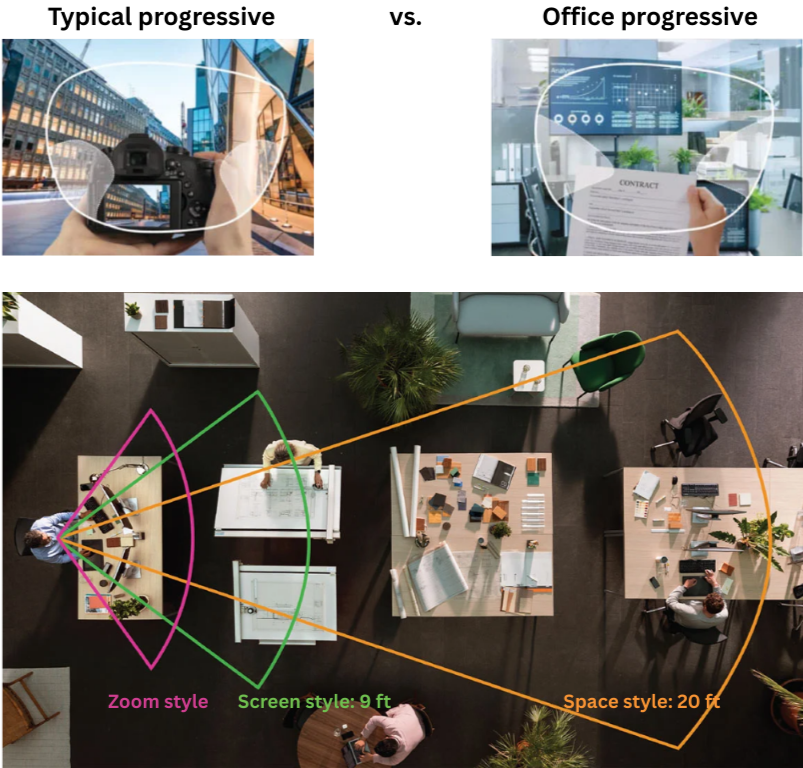
Price range: $630-910 depending on your recommended index
Ideal wearer: Patients who spend lots of time in indoor environments, doing activities that require near and intermediate vision like looking at a computer, reading, and walking around interior spaces. A comfortable option for activities like office work, teaching, and cooking.
Pros:
Optimized for the most comfortable vision at near and intermediate distances
Features a wider field of vision for near and intermediate distances compared to other progressive options.
Designed to eliminate the need for head tilting while working, reducing possible neck discomfort
Available in multiple styles to best suit your needs
May help reduce eye strain for tasks that are detail oriented or on a screen
Cons:
Not designed for distance vision greater than 20 feet away
Wearers may require a second set of progressive lenses for day to day life
Our recommended office progressive: Hoya’s iD Workstyle. Available in three styles (zoom, screen, or space) to best suit your primary tasks.
Intermediate progressive lenses:
Price range: $728-1008 depending on your recommended index
Ideal wearer: ideal for patients who seek a balance between cost and experience.
Pros:
Features technology like Hoya’s Binocular Harmonization Technology (BHT) to limit peripheral distortion, allowing for wider fields of vision and more even appearing optical images if you require different prescription powers in your left and right eyes.
More economical than premium options while still providing a comfortable experience
Cons:
Best for users with low to moderate prescriptions, patients with high prescriptions may find they still experience noticeable peripheral distortion
May require a longer adaption period due to users having to find the prescription zones in the lenses.
Our recommended intermediate progressive: Hoya’s Maestro Gen 2+
Advanced progressive lenses:
Price range: starting at $886-1166 depending on your recommended index
Ideal wearer: Patients who want to be able to focus quickly in all visual zones, and patients who wear their glasses consistently.
Pros:
“softer” style of progressive reduces distortion in your peripheral vision, due to a customized and more gradual transition between prescription powers along the edges of the lens.
Features technology like Hoya’s Binocular Harmonization Technology (BHT) to limit peripheral distortion, allowing for wider fields of vision and more even appearing optical images if you require different prescription powers in your left and right eyes.
Available in multiple styles to best suit your lifestyle
Cons:
Higher price
Our recommended standard progressive: Hoya’s Daynamic Pro or Nikon’s Persio Power
Premium progressive lenses:
Price range: $1054-1334 depending on your recommended index
Ideal wearer: patients wanting the most comfortable and seamless wearing experience, and patients who will be wearing their glasses habitually.
Pros:
Easy and instant focusing capabilities at all distances
Provides the widest fields of vision with the most minimal peripheral distortion out of all progressive lens options
Front and back side surfacing technology allows our laboratories to make lots of minute adjustments based on your eye measurements and natural movement of your eyes on the front and back side of the lenses in order to create the most comfortable and natural wearing experience
Available in multiple options to best suit your lifestyle
Cons:
Higher price
Once patients become accustomed to a premium progressive lens, they often find it difficult to downgrade to more basic progressive options.
Our recommended premium progressive: Hoya’s Lifestyle 4
Why we recommend Hoya progressive lenses
You may have noticed that we highly recommend Hoya lenses. Hoya progressives are known for their cutting-edge precision, technology, comfort, and vision clarity. Additionally, Hoya offers a wide range of progressive styles within their ecosystem. This allows us to select a progressive lens style that will best suit each of our patients’ specific needs, and in rare cases it allows us to switch patients to an alternative more suitable progressive style if required (please note that some restrictions apply in these scenarios).
Why can I buy progressive lenses from other retailers like Specsavers for $150? What is the difference?
Yes, rudimentary basic progressive lenses are available at online and discount retailers like Specsavers and Kits for prices as low as $150. The difference between their lenses and ones purchased from a medical or opticians office are in the lenses accuracy, customization, technology, and quality.
Accuracy and customization: By providing lens manufacturers with precise measurements about your eyes and how your pupils naturally move, we can tailor your progressive lens to ensure the most comfortable and natural user experience. In an optometry office, we take several different measurements of your eyes to customize your progressive lens such as pupillary distance, near pupillary distance, segment height. We will also take your lifestyle and preferences into consideration, and adjust the measurements accordingly. While progressive lenses from online glasses retailers can be significantly cheaper, they often use stock lenses and general “one size fits all” measurements resulting in narrow fields of vision and more distortion due to the lack of personalization and inaccuracies of the lens centration.
Technology and quality: To be able to provide progressive lenses at a lower cost many online retailers design and produce their own frames and lenses in house in massive quantities, typically with less advanced technology and lower quality materials. Due to the use of more basic lens technology users may also experience a more cumbersome progressive experience, and struggle with distortion and narrow fields of vision. Additionally, the lenses and coatings you receive from these suppliers may not hold up to the wear and tear of everyday usage
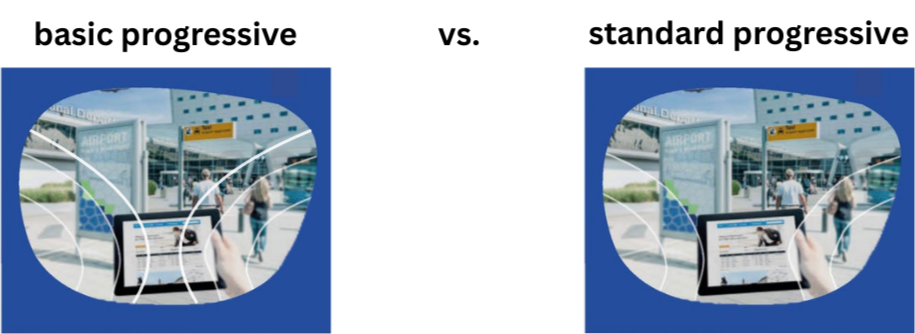
A basic vs. a standard progressive: A basic progressive has a more narrow field of vision
What are the best progressive lenses? What is the best progressive for beginners?
It’s important to find the right balance between your lifestyle, visual needs, and budget when it comes to selecting the right progressive lenses for you. Progressive lenses aren’t one-size-fits-all, and neither are your vision needs! If you wear glasses all day, investing in a higher-quality lens can make a big difference in your comfort, vision clarity, and even help reduce eye strain. On the other hand if you only plan on wearing your progressives occasionally or need a backup pair, a standard progressive lens may be all you need. Please see below for our general recommendations on progressive lens options.
Our general recommendations on the best progressive lens for you!
Here is a general guide to the most common priorities and concerns patients have when selecting their progressive lens
The best progressive lens for beginners: We recommend a premium or advanced progressive like Hoya’s Lifestyle 4 lens or Daynamic Pro lens, to ensure your transition into using progressives is as smooth as possible. A premium progressive will provide easier adaptation and the widest fields of vision. Alternatively, patients who are beginners to progressives typically have more miminal differences between their reading and distance prescriptions. Because of this an advanced lens can often be a great place to start because there will inherently be less peripheral distortion when the prescription difference from the top to bottom of the lens is more minimal.
The progressive lens for the most comfortable and natural wearing experience: We recommend a premium progressive such as Hoya’s Lifestyle 4 lens, which offers the widest fields of vision on the market, with the least amount of distortion
The best progressive lens for a balance of comfort, clarity, and cost: We recommend an advanced or intermediate progressive option such as Hoya’s Daynamic lens. These lenses are a good middle ground. They feature more advanced technology than a standard lens, but are more affordable than a premium option.
The best progressive for patients who do a lot of computer work or primarily use their glasses indoors: We recommend an office progressive like Hoya’s iD Workstyle lens in a style most suited to your tasks
The best progressive for patients prioritizing budget, or patients who will only be wearing progressives occasionally: We recommend a standard progressive, such as Hoya’s Maestro Gen 2 lens
We are here to help you!
Whether you would like advice on choosing the best progressive lens for you, want to deep dive into the technology behind our progressive lenses, or are ready to purchase new glasses, our team at View Optometry is here to help! To speak to our View Crew, please give us a call at 604 770 2095 or book an appointment online.